


Back to News/Events...
November 2026: Patient Spotlight
Rudy’s Story: Equine Facial Nerve Paralysis
Rudy is the cutest mini with the biggest personality! He had a traumatic injury that caused a fracture to the stylohyoid bone, leading to equine facial nerve paralysis.
The equine stylohyoid bones are a pair of long, thin, flat bones (one on each side) that act like suspension rods holding up a horse’s tongue and voicebox. They are the largest part of the hyoid apparatus — a sling-like group of small bones tucked between the two sides of the lower jaw.
The initial inflammation and bone remodeling put pressure on Rudy’s facial nerve, resulting in facial paralysis. In horses, this can lead to inability to blink the eyelid, a floppy ear, and their muzzle deviating away from the injured side.
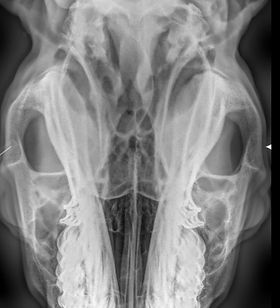

Rudy was diagnosed with radiographs (x-ray images) and a CT scan.
Dr. Nick Carlson and the Steinbeck Peninsula Equine Clinics surgical team removed a segment of the fractured bone to relieve pressure on the nerve. Post-operatively, Rudy was managed on anti-inflammatories, vitamin E supplementation, and continued laser and acupuncture treatment by Dr. Kayla Dykstra, to help stimulate nerve function.
Due to the lack of eyelid function, Rudy had developed a corneal ulcer so he required continued treatment to ensure the eye stayed hydrated. Rudy’s owners also got him a visor to help protect his eye.
What is equine facial nerve paralysis?
The facial nerve, also known as cranial nerve VII, controls many of the muscles responsible for facial movement, including those that help the horse blink, move its lips, and control its nostrils and ears. When this nerve is damaged, a horse may develop weakness or paralysis on one side of the face. In some cases, both sides can be affected.
What causes equine facial nerve paralysis?
Several conditions can lead to facial nerve paralysis in horses, including:
-
Trauma or pressure: Kicks, falls, prolonged recumbency, or pressure from a halter can damage the nerve.
-
Ear or guttural pouch disease: Infections affecting these structures can involve the facial nerve.
-
Temporohyoid osteoarthropathy (THO): This disorder affecting the bones and joints near the horse’s middle and inner ear can cause neurological signs.
-
Neurological disease: Certain diseases affecting the brain or central nervous system can also cause facial paralysis.
What signs should horse owners watch for?
Clinical signs may include:
-
A drooping ear or lip on one side
-
An uneven or deviated muzzle
-
Difficulty blinking or completely closing one eyelid
-
An inability to flare the affected nostril normally
-
Dropping feed while chewing or excessive drooling
-
Feed collecting between the cheek and teeth
If you notice a drooping lip, an uneven muzzle, or difficulty blinking, contact your veterinarian promptly.
Why is this condition concerning?
One of the most important complications is the inability to blink normally. If the eyelid cannot close properly, the eye may become dry and vulnerable to injury, including corneal ulcers. Eye complications can develop quickly, so any horse that cannot blink or close an eyelid normally needs prompt veterinary evaluation. Learn more about equine corneal ulcers ...
Can a horse recover from equine facial nerve paralysis?
Yes, recovery is possible, particularly when the underlying cause can be treated and the nerve has not sustained severe damage. However, recovery varies considerably, and some horses experience persistent facial weakness or paralysis. Nerves can take weeks to months to recover.

Steinbeck Peninsula Equine Clinics Veterinary Assistant Kylie Brown and Dr. Kayla Dykstra with Rudy

Over the course of the next few months, Rudy’s nerve function has gradually improved. He still has a way to go, but slowly and steadily, he is showing progress with weekly acupuncture sessions.

Posted with owner permission.